
Jason Kelce has taken an unconventional approach to address the enormous amount of water consumed by AI data centers.
The retired Philadelphia Eagles legend stars in an ad campaign urging citizens to donate their pee to cool data centers.
Jason does take part in advocacy from time to time and recently put his beer-drinking skills to work to raise money for the Eagles Autism Foundation at his annual bash.
Jason Kelce thinks there’s a better way to handle the issue of AI data centers consuming huge amounts of water.
In a bizarre new advertising campaign, the former football star joined forces with canned water giant Liquid Death and light beer brand Garage Beer, which he co-owns with his brother Travis, to take a stand against the enormous environmental impact of AI infrastructure.
The campaign starts with a shot of Jason filling up a glass jar with urine while speaking to viewers.
“AI data centers waste millions of gallons of water. That’s why Liquid Death and Garage Beer have decided to team up. We want your pee … to cool these data centers,” he says.
Kelce’s Pee Pitch Highlights A Real AI Problem
The video then cuts to a scene in which he performs a song asking for “endless gallons of pee” and encouraging viewers to send it to data centers.
In another scene, a crowd of people can be seen taking jars of urine to the post office, with a disclaimer saying, “The suits want us to tell you to please don’t actually send your pee.”
The move was a promotional effort for Liquid Death’s sparkling energy drinks and Garage Beer, which Jason co-owns with his brother, Kansas City Chiefs star Travis Kelce.
While the campaign is satirical, it draws attention to a very real ecological concern that has sparked tense debate online.
A study funded by the Department of Energy found that data centers across the United States consumed 66 billion liters of water, while another study found that local community water systems could require $10 billion to $58 billion in new infrastructure by 2030.
Jason Kelce Has Used His Platform To Support Good Causes
 3
3Jason is no stranger to speaking up on societal issues and championing causes close to his heart.
Back in June, the New Heights podcast cohost put his drinking skills to good use during the annual Eagles Autism Foundation fundraiser in New Jersey.
The event saw him compete against a patron in the Beer Bowl, where they drank to become the champion and win a $50,000 prize. Jason won the drinking competition and reportedly donated $50,000 of his own money to the fundraiser, per the New York Post.
Sam Altman Calls AI Water Consumption Claims ‘Fake’
 3
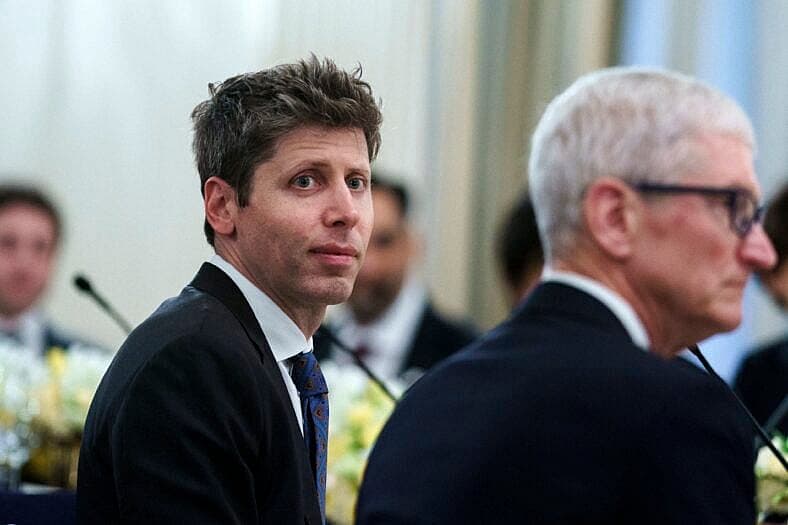
3Meanwhile, OpenAI boss Sam Altman dismissed concerns about data centers consuming large amounts of water as “fake,” arguing that humans also consume energy.
He made the assertion while weighing in on some of the common criticisms the new technology continues to garner during the India AI Impact Summit.
Altman noted at the time that rumors suggesting ChatGPT uses gallons of water per query were “completely untrue, totally insane” and have “no connection to reality,” per CNBC.
Sam Altman Says AI’s Energy Demands Matter More Than Water
 3
3While data centers traditionally rely on large amounts of water to cool operating systems and prevent overheating, some evolved models don’t require it at all.
In his address, Altman implied that energy availability was a far more critical concern to the advancement of AI than water.
“Not per query, but in total – because the world is using so much AI … and we need to move towards nuclear or wind and solar very quickly,” he said.
He then pushed back against a previous comment by Bill Gates that the efficiency of the human brain suggests AI will become progressively more energy-efficient.
“One of the things that is always unfair in this comparison is people talk about how much energy it takes to train an AI model … But it also takes a lot of energy to train a human,” he said. “It takes like 20 years of life, and all the food you eat before that time, before you get smart.”
“The fair comparison is if you ask ChatGPT a question, how much energy does it take once a model is trained to answer that question, versus a human, and probably AI has already caught up on an energy efficiency basis, measured that way,” he added.